
Introduction
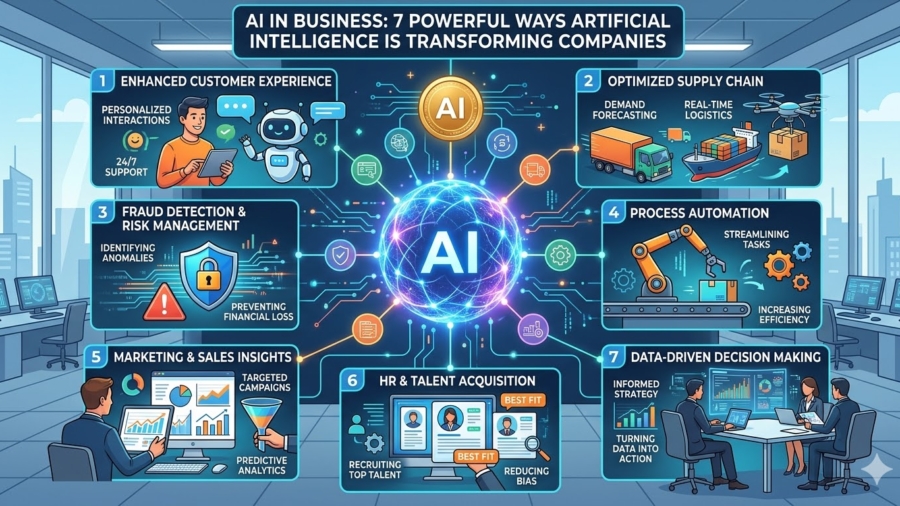
AI in business is transforming how companies operate in today’s digital economy. Organizations are increasingly using artificial intelligence to automate processes, analyze large volumes of data, and make smarter strategic decisions. Because of these advantages, many companies are investing heavily in intelligent technologies to remain competitive.
As digital transformation accelerates, the role of artificial intelligence in modern organizations continues to grow.
Understanding AI in Business
Artificial intelligence in companies refers to the use of technologies such as machine learning, automation systems, and advanced data analytics to improve business operations.
For example, businesses can analyze customer behavior, predict market trends, and optimize workflows using AI-powered tools. These capabilities allow organizations to operate more efficiently and respond faster to market changes.
1. AI in Business Improves Decision-Making
One of the most significant advantages of AI in business is its ability to support better decision-making. AI systems can process large datasets quickly and identify patterns that would be difficult for humans to detect.
As a result, managers can make more informed decisions based on data insights rather than assumptions.
2. AI in Business and Operational Efficiency
Automation is another key benefit of adopting artificial intelligence technologies. Many organizations now use AI solutions to automate repetitive tasks such as scheduling, data entry, and reporting.
By reducing manual work, companies can improve productivity and allow employees to focus on more strategic responsibilities.
3. Improving Customer Experience in AI-Powered Businesses
Artificial intelligence tools are also helping businesses deliver better customer experiences. Chatbots, recommendation engines, and personalized marketing systems enable companies to respond quickly to customer needs.
These technologies help organizations provide faster service and more personalized interactions.
4. Reducing Operational Costs
Companies implementing AI in business often experience lower operational costs. Intelligent systems optimize resource management and reduce the need for manual processes.
Consequently, businesses can increase efficiency while maintaining high levels of performance.
5. Smarter Data Analysis
Modern organizations generate massive amounts of data every day. AI-powered analytics platforms allow companies to process this information quickly and extract valuable insights.
This enables leaders to identify trends, evaluate performance, and improve strategic planning.
6. Driving Innovation Across Industries
Artificial intelligence technologies are driving innovation across many industries, including finance, healthcare, retail, and manufacturing.
Businesses are using intelligent systems to develop new products, optimize services, and improve operational strategies.
7. The Future of Work
The rise of AI in business is also shaping the future of work. While automation can replace certain repetitive tasks, it also creates opportunities for new roles focused on managing and developing AI technologies.
Organizations that invest in digital skills and AI knowledge will be better positioned for future growth.
Looking Ahead
The adoption of intelligent technologies will continue to increase in the coming years. As AI tools become more advanced, companies will rely on them for automation, analytics, and strategic decision-making.
Businesses that adopt these technologies early will gain a strong competitive advantage.
Conclusion
AI in business is reshaping modern organizations by improving efficiency, enabling smarter decisions, and enhancing customer experiences. As artificial intelligence continues to evolve, it will play an even greater role in helping companies innovate and grow in the digital economy.
According to research published by the AI adoption study
Best 3 AI Tools in 2026